Minnesota entered the Union as the 32nd state on May 11, 1858. Here is its history in one place: 58 historic sites you can visit (19 free), 25 National Historic Landmarks, 40 historic tours and trails, 24 history events and a 60-event timeline, each checked against an official page.
Header photo: Minnesota’s third State Capitol, designed by Cass Gilbert, just after its completion in 1905. Credit: Arnold D. Roth, Hennepin County Library via Minnesota Digital Library/DPLA, public domain, via Wikimedia Commons.
- 185832nd state (May 11, 1858)
- 58historic sites to visit
- 25National Historic Landmarks
- 40tours and trails
- Minnesota history by era
- Historic sites by region
- Tours and trails
- History events
- Markers, archives, America 250
Minnesota is the homeland of the Dakota and Ojibwe, whose sacred places such as Bdote, Pipestone and Jeffers reach back thousands of years, and its history runs through the fur trade, Fort Snelling, the US-Dakota War of 1862, St. Anthony Falls flour milling and Iron Range mining.
Minnesota history by era
The short version, era by era. Every date is on the full 60-event timeline with its source.
- ca. 9,000 BCE to 1600s/1700s CE: Carvers began making the Jeffers Petroglyphs, an estimated 11,000-year span of rock carvings on a long rock ridge in Cottonwood County; the earliest date to about 9,000 BCE.
- As long as 10,000 years ago: Native people came to Bdote, the confluence of the Mississippi and Minnesota Rivers, to hunt, fish and celebrate; Dakota people hold the place sacred.
- 1680: Father Louis Hennepin saw the falls the Dakota call Owamniyomni and named them St. Anthony Falls.
- August 22, 1731: Pierre de la Vérendrye landed at Gichi Onigamiing, which grew into a major fur-trade rendezvous point Europeans called Grand Portage.
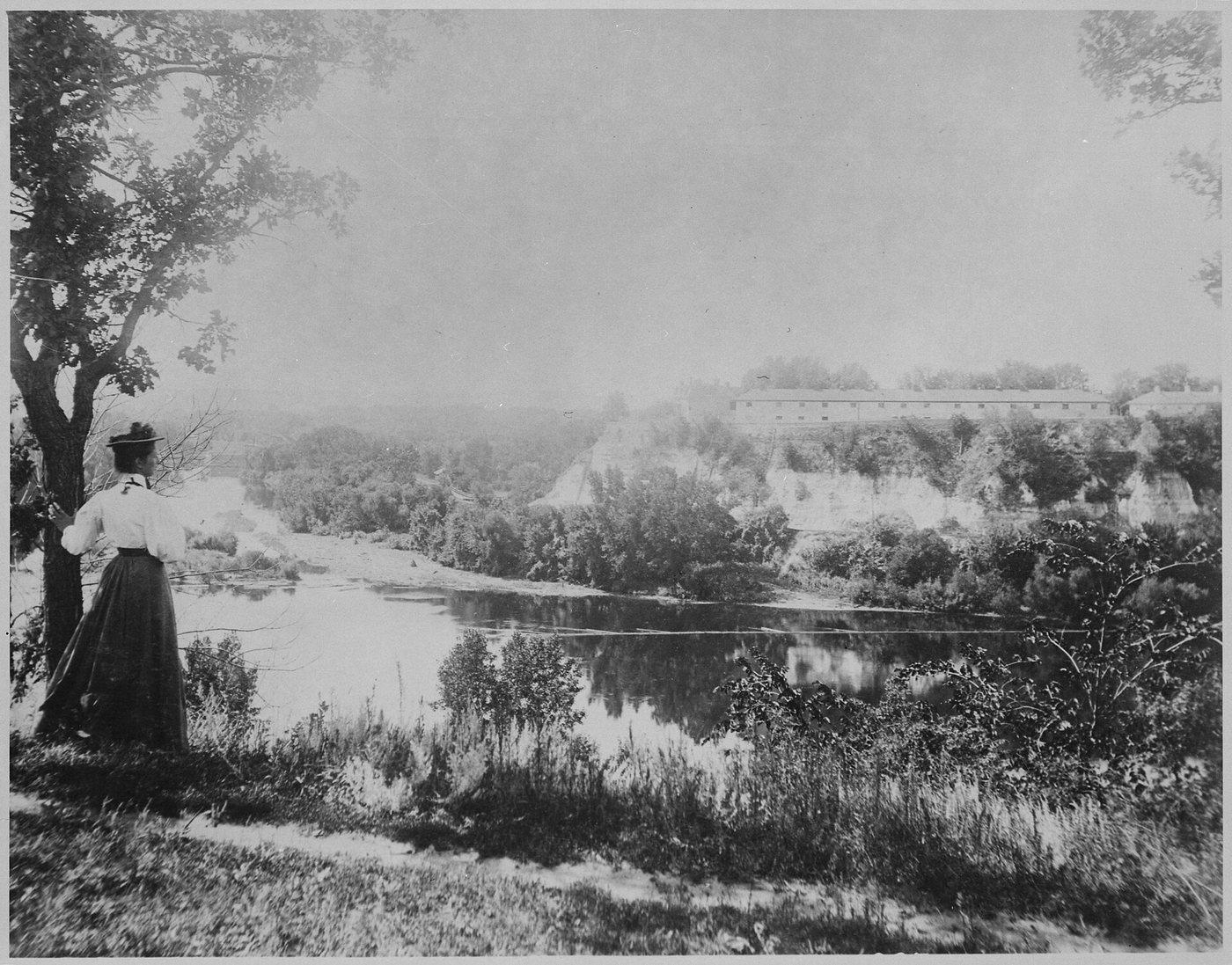
- 1819: Troops began building the fort at Bdote from Platteville limestone quarried from the river bluff.
- 1836: Indian agent Lawrence Taliaferro, who enslaved people, officiated the marriage of Harriet Robinson and Dred Scott; the Scotts later cited their Fort Snelling residence in Scott v. Sandford.
- March 3, 1849: Minnesota became a U.S. territory under the Organic Act of 1849, with St. Paul as the temporary seat of government.
- 1851: The Treaties of Traverse des Sioux and Mendota were signed; the U.S. government acquired millions of acres from the Dakota, and settlers and speculators poured in.
- May 11, 1858: Congress passed and President James Buchanan approved the bill admitting Minnesota to the Union; state officers took their oaths on May 24, 1858.
- April 12, 1861: On the day the Civil War began, Gov. Alexander Ramsey pledged 1,000 Minnesota troops, the first state to make such an offer; about 25,000 soldiers later passed through Fort Snelling.
- August 17, 1862: Four Dakota hunters killed five settlers in Acton Township; that night a group of Mdewakanton men persuaded a reluctant Ta Oyate Duta to lead a war, amid late annuity payments and traders’ refusal of credit to hungry Dakota.
- Late 1862: After the war the U.S. government nullified its treaties with the Dakota, dissolved their reservation, and publicly executed thirty-eight Dakota men in Mankato, the largest mass hanging in the nation’s history.
- 1874: Cadwallader C. Washburn built the first Washburn A Mill at St. Anthony Falls; an explosion and fire leveled it in 1878 and it was rebuilt.
- 1890: The Merritt family found a large hematite deposit near present-day Mountain Iron, opening the Mesabi Iron Range.
- June 15, 1920: A mob estimated at 10,000 people broke into the Duluth police station and lynched three young Black circus workers, Elias Clayton, Elmer Jackson and Isaac McGhie, who had been falsely accused of rape; no one was ever convicted of their murders.
- May 1927: Little Falls native Charles A. Lindbergh completed the first nonstop solo transatlantic flight.

- 1956–1968: Construction of Interstate 94 cut St. Paul’s Rondo neighborhood, a center of African American life, in half.
- 1968: The American Indian Movement (AIM) was founded by grassroots activists in Minneapolis.
- 2003: The Clayton Jackson McGhie Memorial was dedicated in Duluth across from the lynching site, and Mill City Museum opened in the Washburn A Mill ruins.
- 2020: Minneapolis resident George Floyd was killed while in police custody; on June 15, 2020, more than 1,000 people gathered at the Clayton Jackson McGhie Memorial in Duluth to mark the lynchings’ centennial.
Historic sites to visit, by region
The highlights in each region. Hours, admission and every site are on historic sites in Minnesota.
Historic tours and trails
40 ways to see Minnesota history on foot, by car or with a ranger. All of them: historic tours in Minnesota.
| Tour or trail | Where | Price | When |
|---|---|---|---|
| Summit Avenue Walking Tours | St. Paul | $16-$20 depending on ticket type (see event page) | 2026 season final dates Oct 24, 25 and 31 at 10:15 am; seasonal |
| Minnesota State Capitol guided tours | St. Paul | Free (suggested $5 donation) | Year-round; MNHS lists first tour 9:00 am/last 3:00 pm and first 10:00 am/last 2:00 pm schedules |
| Historic Fort Snelling guided walking tour | St. Paul (Fort Snelling) | Included with site admission ($12 adults) | Thu-Sat 10-4 (fall 2026) |
| Split Rock Keeper’s Tour | Two Harbors | $25 (MNHS members save 20%) | Saturdays Oct 23-Nov 22, 2026; Fri-Sun Jan 1-3, 2027; 12:00, 1:00, 2:30 pm |
| Soudan Underground Mine Tour | Soudan | $15 ages 13+; $10 ages 5-12; 4 & under free | Daily Memorial Day weekend-end Sept; weekends Sept 28-Oct 18 |
| St. Anthony Falls Heritage Trail | Minneapolis | Free | Year-round |
| Pipestone Circle Trail | Pipestone | Free | Open any time of day |
| Birch Coulee Battlefield self-guided trail | Morton | Free | Daily dawn to dusk (not maintained in winter) |
History events coming up
Reenactments, living history and candlelight tours with dates the organizers have posted. All 24: history events in Minnesota.
| Event | Where | When |
|---|---|---|
| Cabinet of Curiosities / Colonial Connections: The Tenney Family in Stearns County | St. Cloud | Jun 1, 2026 to Dec 31, 2026 |
| Free Thursday Nights at the History Center | St. Paul | Oct 22, 2026 to Dec 17, 2026 |
| Lanterns & Legends | St. Paul (Fort Snelling) | Oct 24, 2026 to Oct 30, 2026 |
| Summit Avenue Walking Tours (final 2026 dates) | St. Paul | Oct 24, 2026 to Oct 31, 2026 |
| America at 250 Concert Series: A Day in the Life of a Soldier | Thief River Falls | Nov 10, 2026 |
| Edmund Fitzgerald: A Great Lakes Memorial (beacon lighting) | Two Harbors | Nov 10, 2026 |
| Lifting the Veil: A Glimpse at 19th Century Spiritualism | Elk River | Nov 14, 2026 |
| Millers’ Tour | Minneapolis | Nov 14, 2026 to Dec 13, 2026 |
Historical markers, archives and America 250
| Program | Run by | What it is | Link |
|---|---|---|---|
| Minnesota Historical Society historic sites network | Minnesota Historical Society | Statewide network of historic sites and museums (26 historic sites and museums (MNHS membership text); the locations page lists 27 locations because it also counts the Gale Family Library) | Official page |
| Minnesota History Along the Highways (marker guide) | MNHS Press (Minnesota Historical Society) | Guide to the state’s highway historical markers and texts (254 historic markers, 60 geological markers, 29 historic monuments) | Official page |
| National Register of Historic Places in Minnesota | Minnesota State Historic Preservation Office (Dept. of Administration) | Official list of properties worthy of preservation; Minnesota listings (More than 1,750 listings covering over 6,000 properties (SHPO); 1,773 listings (NPS, FY2020)) | Official page |
| National Historic Landmarks in Minnesota | NPS / Minnesota SHPO | Nationally significant historic places in Minnesota (25 (NPS list and MN SHPO agree)) | Official page |
| Gale Family Library | Minnesota Historical Society | Research library at the Minnesota History Center; free admission; walk-in and appointment research (Not stated) | Official page |
| Minnesota Digital Newspaper Hub | Minnesota Historical Society | Searchable Minnesota newspapers 1849-today; most post-1977 issues viewable only at the Gale Family Library (Millions of pages) | Official page |
| MNopedia | Minnesota Historical Society | Free online encyclopedia of Minnesota history (Not stated) | Official page |
| U.S.-Dakota War of 1862 (website) | Minnesota Historical Society | Stories and resources on the Dakota homeland, newcomers and the 1862 war (Not stated) | Official page |
| Governor’s Committee on Minnesota America 250 | Created by Executive Order 23-11 (Sept 22, 2023); convened by MNHS | Coordinates Minnesota commemorations of the 250th anniversary of the American Revolution (Up to 15 members (EO 23-11)) | Official page |
| Minnesota America 250 events calendar | Governor’s Committee on Minnesota America 250 / MNHS | Statewide calendar of America 250 events, filterable by region; public can submit events (Not stated) | Official page |
National Historic Landmarks
Minnesota has 25 National Historic Landmarks on the National Park Service list. See every Minnesota National Historic Landmark by region, with which ones you can visit.
What we could not verify
- MNHS gives two counts: its membership text says 26 historic sites and museums, while its locations page lists 27 locations because it also counts the Gale Family Library. We use 26.
- The NPS Minnesota page lists 6 park units, but its summary box says 5 national parks (FY2020 figures).
We re-check these when the source pages change. Spot something we missed? Use the corrections page.
Frequently asked questions
When did Minnesota become a state?
Minnesota entered the Union on May 11, 1858, as the 32nd state. It had been organized as a U.S. territory nine years earlier, on March 3, 1849 (source: Minnesota Secretary of State: Minnesota in Profile).
What is the oldest historic site in Minnesota?
The Jeffers Petroglyphs in Cottonwood County are among the oldest. MNopedia dates the earliest carvings to about 9,000 BCE, with carving continuing into the 1600s or 1700s CE. MNHS also says Native people have come to Bdote, where the Mississippi and Minnesota rivers meet, for as long as 10,000 years (source: MNopedia: Jeffers Petroglyphs).
What was the US-Dakota War of 1862?
A six-week war in southwestern Minnesota between settlers and a faction of Dakota people, many starving after broken treaty promises and late annuities. It began on August 17, 1862, and ended at Wood Lake on September 23. Afterward the U.S. hanged 38 Dakota men at Mankato and removed Dakota and Ho-Chunk people from Minnesota (source: MNopedia: US-Dakota War of 1862).
How many historic sites does the Minnesota Historical Society run?
The Minnesota Historical Society runs 26 historic sites and museums, from Historic Fort Snelling and Split Rock Lighthouse to Jeffers Petroglyphs and the Mille Lacs Indian Museum. Its locations page shows 27 locations because it also counts the Gale Family Library. All 26 sites are in our list (source: Minnesota Historical Society: Locations).
Was there slavery in Minnesota?
Yes, at Fort Snelling. MNHS writes that “Minnesota was a free territory, but some military officers moved to the fort with enslaved people.” Dred Scott met and married Harriet Robinson there after 1836, and the Scotts later sued for freedom because they had lived in free territory (source: MNHS: Enslaved African Americans and the Fight for Freedom).
Are there Civil War battlefields in Minnesota?
Minnesota’s battlefields are from the US-Dakota War of 1862, not from Civil War battles. They include Fort Ridgely (August 20 and 22), New Ulm (August 25), Birch Coulee (September 3-4) and Wood Lake (September 23, the war’s last battle). Birch Coulee and Fort Ridgely are free MNHS sites (source: MNopedia: US-Dakota War of 1862).
Last checked October 20, 2026 by the It’s Minnesota editors against each operator’s, agency’s or organizer’s own page.
Sources
- Minnesota Secretary of State: Minnesota in Profile
- National Park Service: places in Minnesota
- National Park Service: National Historic Landmarks program
- MNopedia: Jeffers Petroglyphs
- MNHS: Historic Fort Snelling timeline
- MNopedia: Lake Vermilion–Soudan Underground Mine State Park
- City of Saint Paul: Wic̣aḣapi
- Minnesota Historical Society historic sites network
- Minnesota History Along the Highways (marker guide)
- National Register of Historic Places in Minnesota
- National Historic Landmarks in Minnesota
- Gale Family Library
- Minnesota Digital Newspaper Hub
- MNopedia
- U.S.-Dakota War of 1862 (website)
- Governor’s Committee on Minnesota America 250
- Minnesota America 250 events calendar
Looking for animals instead of history? See our Minnesota Wildlife guide.
Cite this page: It's Minnesota, “Minnesota History: Historic Sites, Landmarks, Tours and Timeline”, itsminnesota.com/history/ (updated ). By the It's Minnesota editorial team. Free to quote with attribution and a link to this page; data and tables are licensed CC BY 4.0.